
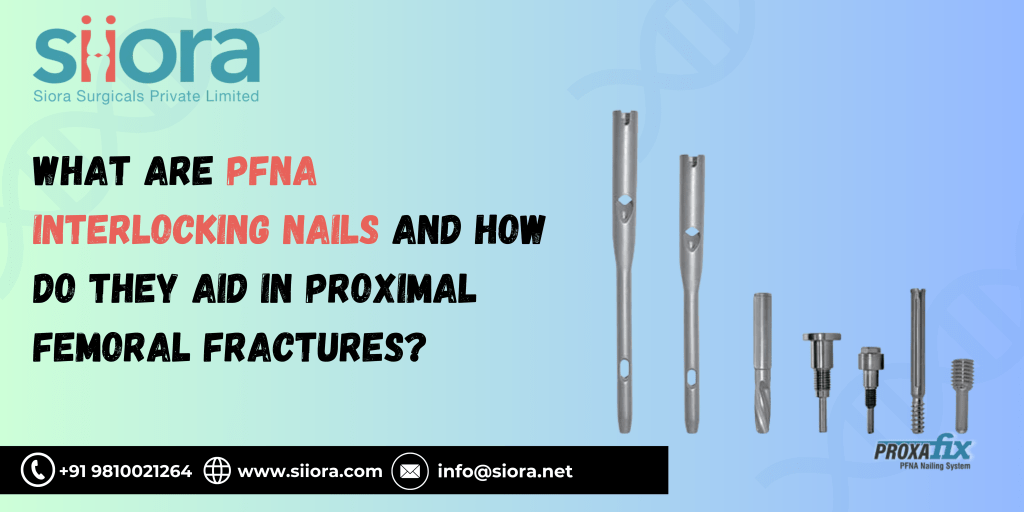
Proximal femoral fractures, commonly known as hip fractures, are among the most prevalent orthopedic injuries, particularly in the elderly population. These fractures often occur due to low-energy trauma such as falls in individuals with osteoporosis or high-energy impacts in younger individuals. Treating proximal femoral fractures is critical to restoring mobility, reducing pain, and preventing complications like deep vein thrombosis or pulmonary embolism. One of the most effective solutions in managing these fractures is the Proximal Femoral Nail Antirotation (PFNA) interlocking nail.
This blog explores what PFNA interlocking nails are, their unique design features, and how they aid in the treatment of proximal femoral fractures.
What Are PFNA Interlocking Nails?
PFNA interlocking nails are specialized orthopedic implants designed for the internal fixation of proximal femoral fractures. These nails are an advancement over earlier intramedullary devices, providing improved stability, ease of insertion, and enhanced post-operative outcomes. Developed by synthesizing the principles of biomechanics and clinical needs, PFNA nails are now a gold standard for treating fractures in the proximal femur.
The PFNA system comprises a nail, an antirotation screw, locking screws, and additional hardware required for surgical fixation. These implants are made from biocompatible materials like titanium or stainless steel, ensuring strength and resistance to corrosion while minimizing the risk of rejection by the body.
Key Design Features of PFNA Interlocking Nails
Proximal Helical Blade
Unlike traditional screws, the PFNA features a helical blade that is inserted into the femoral head. This design enhances bone compaction and provides better anchorage, reducing the risk of implant migration and cut-out.
Intramedullary Fixation
The nail is inserted into the medullary canal of the femur, providing strong internal support and reducing stress on the surrounding soft tissues. This design also minimizes the need for extensive surgical exposure, preserving blood supply to the fractured bone.
Multiple Locking Options
The nail has distal locking options that allow surgeons to customize the fixation based on the patient’s anatomy and fracture pattern. Dynamic and static locking options provide flexibility and rotational stability.
Biomechanical Stability
PFNA nails distribute the load along the intramedullary axis, closely mimicking the natural weight-bearing mechanics of the femur. This reduces stress concentration at the fracture site, promoting faster healing.
How PFNA Interlocking Nails Aid in Proximal Femoral Fractures?
Minimally Invasive Procedure
The PFNA system allows for minimally invasive surgical techniques, which result in smaller incisions, reduced blood loss, and lower risk of post-operative complications. This approach also facilitates faster recovery and less post-operative pain.
Early Mobilization
One of the primary goals in fracture management is to restore mobility as soon as possible. PFNA nails provide the stability required to enable partial or full weight-bearing in the early postoperative period, which is crucial for elderly patients to prevent complications like muscle atrophy or bedsores.
Reduced Risk of Complications
Traditional methods of fixation, such as plates and screws, are associated with higher risks of implant failure, malunion, or nonunion. The PFNA’s helical blade design minimizes the risk of implant cut-out and maintains fracture stability, even in patients with poor bone quality.
Effective in Osteoporotic Bone
Osteoporosis is a common condition in patients suffering from proximal femoral fractures. PFNA nails are specifically designed to compact the surrounding cancellous bone during blade insertion, improving fixation strength in osteoporotic bone.
Shorter Surgical Time
The straightforward design and insertion technique of PFNA nails contribute to reduced operative time. This is particularly beneficial for elderly patients who may not tolerate prolonged anesthesia well.
Enhanced Functional Outcomes
Studies have shown that patients treated with PFNA nails demonstrate superior functional outcomes compared to other fixation methods. They regain independence faster and experience a lower rate of re-operation.
When Are PFNA Nails Recommended?
PFNA interlocking nails are primarily indicated for unstable proximal femoral fractures, including:
- Intertrochanteric fractures
- Subtrochanteric fractures
- Fractures with reverse obliquity
However, the choice of implant depends on factors such as the patient’s age, bone quality, and the nature of the fracture. Surgeons perform a thorough evaluation before deciding on the most appropriate fixation method.
Conclusion
PFNA intramedullary interlocking nails have revolutionized the treatment of proximal femoral fractures, offering a reliable and effective solution for patients of all ages. Their biomechanical superiority, ease of insertion, and ability to address osteoporotic fractures make them a preferred choice for orthopedic surgeons worldwide. By enabling early mobilization and minimizing complications, PFNA interlocking nails significantly enhance the quality of life for patients recovering from proximal femoral fractures.
Siora Surgicals Pvt. Ltd. is a top player in the global orthopedic implant manufacturing industry with experience of over 3 decades. The company has been serving a huge base of distributors in over 50 countries. Additionally, it keeps looking to expand its international market presence by finding distributors in countries where Siora is not present. Currently, the company is looking for distributors of orthopedic implants in Ukraine to establish its presence.
 What You Need to Know About Posterior Lumbar Interbody Fusion (PLIF)?